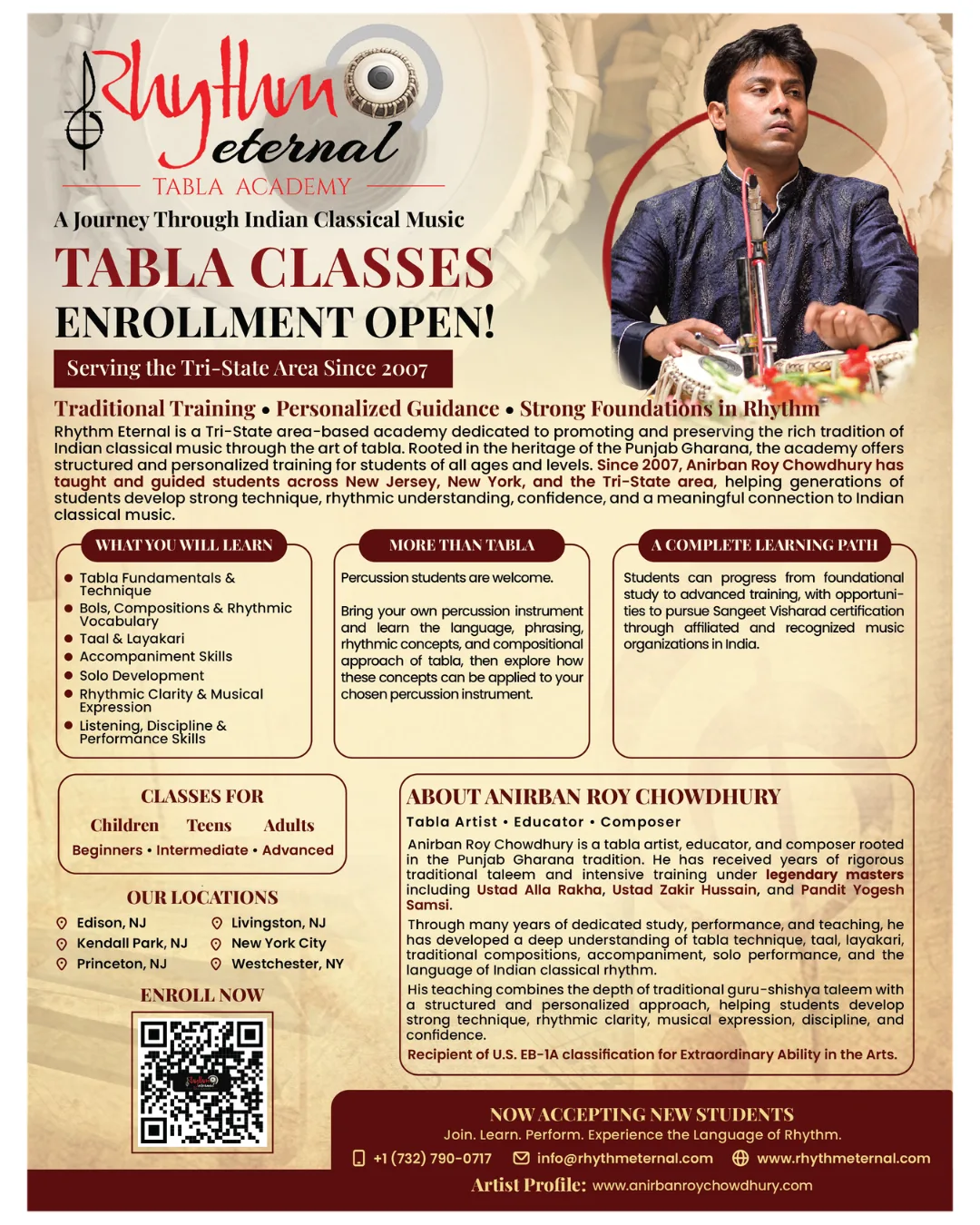

Advanced
Tabla Classes
Refine Your Artistry. Deepen Your Understanding.
Develop Your Individual Musical Voice.

For serious and dedicated students who are ready to pursue tabla
at a deeper artistic and performance level.
Advanced
Tabla Classes
Refine Your Artistry. Deepen Your Understanding.
Develop Your Individual Musical Voice.
For serious and dedicated students who are ready to pursue tabla
at a deeper artistic and performance level.
WHAT YOU WILL GAIN

Advanced
Technique

Deep Understanding
of Taal & Layakari

Rich Traditional Repertoire

Tabla Solo
Performance

Accompaniment
Mastery

Creative Expression
& Musical Maturity
ABOUT THE PROGRAM
At this stage, learning moves beyond technique, speed, and the accumulation of compositions. Students explore the architecture of tabla solo performance, advanced rhythmic concepts, improvisation, traditional repertoire, accompaniment, musical interpretation, stagecraft, and the development of an individual artistic voice.
Under the guidance of internationally acclaimed tabla artist, educator, composer, and Founder & Artistic Director of Rhythm Eternal, Anirban Roy Chowdhury, advanced students receive highly personalized training rooted in the Guru-Shishya Parampara and informed by decades of immersive study, performance, teaching, and artistic experience.
The goal of advanced training is not simply to play more—it is to understand more deeply, listen more carefully, express ideas more meaningfully, and develop the maturity required to become a thoughtful and independent musician.
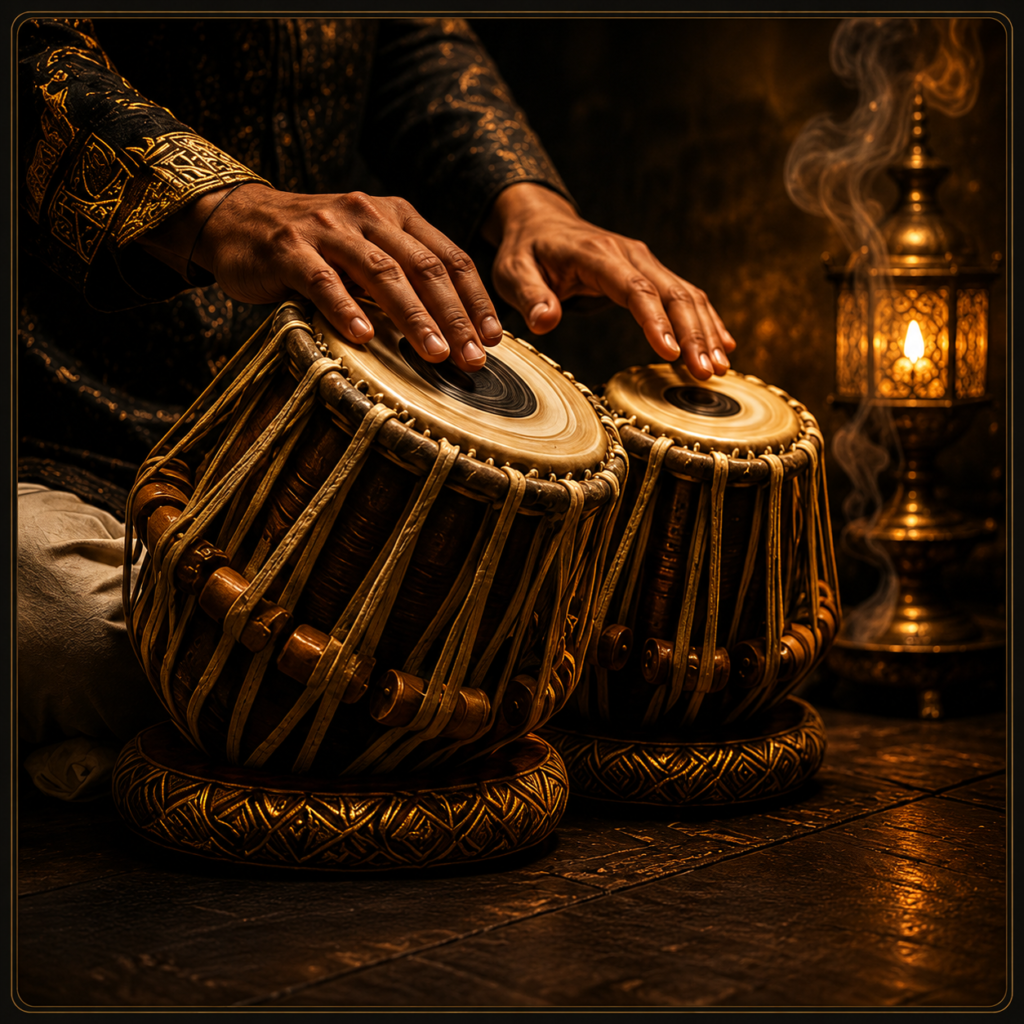
WHAT YOU WILL STUDY
Advanced Traditional Repertoire
- Peshkar, Kaida, Rela, Tukra, Paran, Gat, Chakradar
- Farmaishi & Kamali Chakradar
- Rare & inherited compositions
- Development of ideas
The Art of Tabla Solo
- Designing a complete solo
- Musical continuity
- Pacing & contrast
- Lehra & stagecraft
- Climactic development

Advanced Layakari &
Rhythmic Development
- Complex layakari
- Tihai construction
- Subdivisions & math in taal
- Approaching sam creatively
- Improvisational ideas

Improvisation & Creativity
- Spontaneous improvisation
- Variations & expansion
- Thematic development
- Musical conversation
- Creative independence

Accompaniment Mastery
- Hindustani vocal & instrumental
- Light classical & devotional
- Ghazal, Thumri & more
- Sensitivity, awareness, listening & support

Listening & Analysis
- Listening to great maestros
- Understanding style & phrasing
- Recognizing compositions
- Developing taste & judgement

Stagecraft & Performance
- Stage presence
- Communication
- Handling pressure
- Audience connection

Mentorship & Growth
- Personalized guidance
- Long-term artistic development
- Workshops & masterclasses
- Preparation for examinations
- Sangeet Visharad & beyond
Take Your Tabla Journey
to the Next Level

Develop artistry, depth, and confidence.
Become a thoughtful, expressive, and independent musician.
Advanced Tabla Classes
Refine Your Artistry. Deepen Your Understanding. Develop Your Individual Musical Voice.
The Advanced Tabla Program at Rhythm Eternal is designed for serious and dedicated students who have developed strong technical foundations and are ready to pursue tabla at a deeper artistic and performance level.
At this stage, learning moves beyond technique, speed, and the accumulation of compositions. Students explore the architecture of tabla solo performance, advanced rhythmic concepts, improvisation, traditional repertoire, accompaniment, musical interpretation, stagecraft, and the development of an individual artistic voice.
Under the guidance of internationally acclaimed tabla artist, educator, composer, and Founder & Artistic Director of Rhythm Eternal, Anirban Roy Chowdhury, advanced students receive highly personalized training rooted in the Guru-Shishya Parampara and informed by decades of immersive study, performance, teaching, and artistic experience.
The goal of advanced training is not simply to play more—it is to understand more deeply, listen more carefully, express ideas more meaningfully, and develop the maturity required to become a thoughtful and independent musician.
⸻
From Technical Ability to Artistry
At the advanced level, technical skill becomes a means of musical expression.
Clarity, speed, strength, and control remain essential, but advanced students must learn how to use technique with musical purpose. A mature tabla player understands that every composition has a character, every phrase has direction, and every performance requires sensitivity to context.
At Rhythm Eternal, advanced students work toward developing:
* Technical refinement
* Clarity at different speeds
* Balance between dayan and bayan
* Tonal quality and sound production
* Dynamic control
* Endurance and consistency
* Advanced rhythmic awareness
* Musical phrasing
* Improvisational confidence
* Artistic interpretation
* Performance maturity
* Individual expression
The objective is to help students move from being technically capable players toward becoming thoughtful musicians.
⸻
Advanced Traditional Repertoire
The advanced curriculum provides serious students with opportunities to explore a broad range of traditional tabla repertoire.
Depending on each student’s background, ability, dedication, and musical development, training may include advanced study of:
* Peshkar
* Kaida
* Advanced Paltas
* Rela
* Rau
* Uthan
* Tukra
* Mukhra
* Mohra
* Paran
* Gat
* Tihai
* Chakradar
* Farmaishi Chakradar
* Kamali Chakradar
* Traditional compositions
* Rare and inherited compositions
* Development and expansion of compositional ideas
Students learn compositions not merely as fixed sequences of bols, but as musical forms with structure, grammar, character, and possibilities for artistic development.
The emphasis is on understanding the internal logic of a composition: how an idea begins, how it develops, how variations are created, how tension and release are shaped, and how the composition returns meaningfully to the sam.
⸻
The Art of Tabla Solo
Tabla solo is one of the most sophisticated rhythmic art forms within Indian Classical Music.
At the advanced level, students study how different forms of tabla repertoire can be organized into a meaningful and compelling solo presentation. The goal is not simply to play a sequence of compositions, but to understand the architecture, pacing, contrast, development, and emotional direction of a complete performance.
Advanced solo training may include:
* Designing the structure of a tabla solo
* Developing musical continuity
* Transitioning between compositional forms
* Pacing a performance
* Presenting traditional repertoire with clarity
* Balancing prepared material and improvisation
* Communicating with lehra accompaniment
* Understanding the relationship between composition and spontaneous development
* Creating contrast between weight, speed, space, and intensity
* Building toward climactic rhythmic ideas
* Stage presentation and audience communication
Students are encouraged to understand the identity and character of every composition they perform.
A mature tabla solo should not sound like a list of memorized pieces. It should unfold as a musical journey.
⸻
Advanced Layakari & Rhythmic Development
At the advanced level, students explore increasingly sophisticated relationships between taal, laya, composition, and improvisation.
Training focuses on developing a strong internal sense of time and the ability to navigate complex rhythmic ideas without losing musical clarity.
Students may work on:
* Advanced layakari concepts
* Rhythmic subdivisions
* Complex tihai construction
* Understanding mathematical relationships within taal
* Improvisational development
* Creating variations within traditional structures
* Maintaining rhythmic stability through complex passages
* Approaching the sam from different rhythmic perspectives
* Developing confidence in spontaneous rhythmic interaction
At Rhythm Eternal, advanced rhythmic study is never approached as mathematics alone. The goal is always to transform rhythmic intelligence into musical expression.
Complexity has value only when it communicates musically.
⸻
Composition, Development & Improvisation
At the advanced stage, students begin developing a deeper understanding of how musical ideas are constructed and expanded.
A student may know hundreds of compositions, but true musical growth begins when the student understands the principles behind those compositions.
Through guided study, students explore:
* The grammar of traditional compositions
* Theme and variation
* Development of a kaida
* Expansion of rhythmic ideas
* Improvisational discipline
* Creating musical continuity
* Understanding when to develop and when to conclude
* Balancing tradition and personal expression
* Building meaningful rhythmic phrases
* Developing artistic judgment
Improvisation is approached with discipline and respect for tradition. Students are encouraged to develop creativity from a foundation of knowledge, listening, experience, and deep understanding.
⸻
The Art of Accompaniment
Advanced tabla training must include a deep understanding of accompaniment.
A great accompanist does much more than maintain the taal. Accompaniment requires extraordinary listening, musical sensitivity, knowledge of repertoire, awareness of the main artist’s phrasing, and the ability to respond appropriately in the moment.
Advanced students explore the different responsibilities and aesthetics of accompanying:
* Hindustani classical vocal music
* Khayal
* Dhrupad-related rhythmic understanding where appropriate
* Thumri and light-classical forms
* Instrumental music
* Sitar
* Sarod
* Santoor
* Sarangi
* Flute
* Slide guitar and other Indian classical instruments
* Bhajan and devotional music
* Ghazal
* Appropriate contemporary and collaborative settings
Students learn that each musical form requires a different approach.
The tabla should not dominate every musical situation. Advanced accompaniment training develops the ability to listen deeply, support sensitively, respond intelligently, and contribute to the overall musical experience.
⸻
Learning How Music Lives Beyond the Classroom
The philosophy behind advanced training at Rhythm Eternal comes from a musical education that extended far beyond formal lessons.
Founder & Artistic Director Anirban Roy Chowdhury trained for seven years under the legendary Ustad Allah Rakha, followed by more than a decade of rigorous and immersive training under Pandit Yogesh Samsi in Mumbai. He has continued his advanced training for more than fifteen years under Padma Vibhushan Ustad Zakir Hussain in the United States.
Following the traditional spirit of the Guru-Shishya Parampara, Anirban’s education was not limited to scheduled lessons. His days were immersed in learning, practice, observation, musical discussions, rehearsals, and listening. Evenings often continued in the concert hall, where the same musical vocabulary studied during training could be experienced in a completely different artistic context.
A composition learned and practiced during the day might later appear in a tabla solo, be subtly adapted during accompaniment, or be transformed spontaneously through interaction with another great artist on stage.
This continuous relationship between learning, listening, observation, practice, and live performance created an understanding of music that goes far beyond memorization.
This philosophy is central to advanced training at Rhythm Eternal.
Students are encouraged not only to ask:
What should I play?
but also:
Why should I play it?
When should I play it?
How should I shape it?
What does the music need at this moment?
These questions are central to the development of a mature artist.
⸻
Listening, Observation & Musical Analysis
Advanced musicians must become advanced listeners.
At Rhythm Eternal, students are encouraged to study great performances critically and thoughtfully. Listening assignments and musical discussions may explore tabla solos, vocal accompaniment, instrumental accompaniment, compositional interpretation, interaction between artists, and different approaches to taal and laya.
Students learn to observe:
* Tonal quality
* Phrasing
* Choice of repertoire
* Development of compositions
* Improvisational decisions
* Dynamics
* Use of space and silence
* Interaction between artists
* Accompaniment choices
* Stage communication
* Structure of an entire performance
The purpose is not to imitate another musician. The purpose is to understand how great musicians think, listen, respond, and create.
⸻
Developing an Individual Musical Voice
Tradition and individuality are not opposites.
A strong individual musical voice develops through years of disciplined learning, deep listening, performance experience, and respect for tradition.
Advanced students at Rhythm Eternal are encouraged to gradually discover their own musical identity while remaining grounded in authentic knowledge.
This process may involve:
* Understanding personal technical strengths
* Identifying areas that require development
* Exploring repertoire deeply
* Developing thoughtful improvisation
* Building a personal performance approach
* Learning to make artistic decisions independently
* Understanding musical responsibility
* Developing confidence without losing humility
The goal is not to manufacture individuality. Genuine artistic identity develops naturally through knowledge, experience, discipline, and reflection.
⸻
Performance Preparation & Stagecraft
Advanced training includes preparation for serious performance situations.
Students learn that successful performance requires much more than knowing compositions.
Performance preparation may include:
* Designing a performance sequence
* Selecting appropriate repertoire
* Time management on stage
* Working with lehra accompaniment
* Soundcheck awareness
* Microphone awareness
* Stage presence
* Communicating with fellow musicians
* Recovering from unexpected musical situations
* Managing performance pressure
* Maintaining concentration
* Understanding audience communication
* Professional rehearsal discipline
Students preparing for solo recitals, accompaniment opportunities, auditions, competitions, or other important performances may receive focused guidance based on their specific needs.
⸻
Composition & Creative Exploration
As a tabla artist and composer, Anirban Roy Chowdhury also encourages advanced students to understand the relationship between tradition and creativity.
Students with appropriate preparation may explore how rhythmic ideas can interact with:
* Indian Classical Music
* Original compositions
* Cross-cultural collaborations
* Contemporary musical settings
* Ensemble work
* Rhythmic arrangements
* Interdisciplinary artistic projects
Creative exploration is always approached from a position of musical knowledge and respect for tradition.
The objective is not to dilute classical training, but to help serious students understand how a strong foundation can support meaningful artistic exploration.
⸻
Mentorship Beyond the Lesson
Advanced students often need more than weekly instruction. They need mentorship.
At Rhythm Eternal, serious students may receive guidance in areas such as:
* Long-term musical development
* Practice strategy
* Repertoire planning
* Solo preparation
* Accompaniment preparation
* Performance opportunities
* Audition preparation
* Competition preparation
* Examination pathways
* Teaching development
* Professional conduct
* Artistic decision-making
Every student’s journey is different. Advanced mentorship is therefore personalized according to individual goals, strengths, challenges, and artistic direction.
⸻
Performance Opportunities & Musical Community
Advanced students may have opportunities to participate in appropriate musical activities through Rhythm Eternal, including:
* Student recitals
* Advanced student showcases
* Community concerts
* Workshops
* Masterclasses
* Lecture demonstrations
* Ensemble collaborations
* Accompaniment opportunities
* Cultural presentations
* Special artistic projects
Participation is based on musical readiness and the needs of each event.
Performance is treated as an extension of education—a place where preparation, listening, discipline, creativity, and communication come together.
⸻
Advanced Curriculum & Formal Study
Rhythm Eternal follows a progressive learning path from Beginner through Intermediate and Advanced Tabla.
Students pursuing structured academic development may receive guidance toward appropriate Indian Classical Music examination pathways, including Sangeet Visharad, according to their preparation and individual goals.
Advanced training may also support students who wish to pursue:
* Higher-level music examinations
* Solo performance
* Professional accompaniment
* Teaching
* Academic study of Indian Classical Music
* Auditions and competitions
* Long-term professional development
Formal qualifications can be valuable milestones, but at Rhythm Eternal, examination success is considered one part of a larger musical education.
The ultimate goal is musicianship.
⸻
Who Is the Advanced Tabla Program For?
The Advanced Tabla Program is intended for serious students who:
* Have strong foundational technique
* Have completed substantial intermediate training
* Can maintain taal confidently
* Have experience with traditional compositions
* Understand fundamental principles of kaida and rela development
* Have begun exploring solo presentation
* Have some understanding of accompaniment
* Are committed to disciplined practice
* Want to deepen their knowledge of traditional repertoire
* Wish to develop improvisation and artistic expression
* Are preparing for serious performance or advanced musical study
Admission to advanced training is based on evaluation of the student’s current technical level, repertoire, rhythmic understanding, musical maturity, and goals.
The number of years studied alone does not determine advanced placement.
⸻
Flexible Advanced Training Options
Private Advanced Lessons
Highly personalized one-on-one training for serious students focusing on technique, repertoire, improvisation, solo performance, accompaniment, or specific artistic goals.
Advanced Group Training
Selected students may participate in appropriate group sessions focused on repertoire, rhythmic development, listening, ensemble awareness, and musical interaction.
Online Advanced Tabla Training
Live interactive advanced training is available for dedicated students across the United States and internationally. Online study may include repertoire, technique, practice strategy, musical analysis, and performance preparation.
In-Person Advanced Training
Face-to-face instruction offers detailed technical guidance, close musical interaction, and opportunities to participate in the wider Rhythm Eternal musical community.
⸻
Why Choose Rhythm Eternal for Advanced Tabla Training?
Advanced musical training requires more than access to difficult compositions.
It requires lineage, knowledge, observation, musical experience, performance understanding, careful correction, and long-term mentorship.
At Rhythm Eternal, advanced students benefit from:
* Authentic Guru-Shishya lineage
* Decades of immersive musical training
* Advanced traditional repertoire
* Personalized technical development
* Solo performance guidance
* Accompaniment training
* Layakari and rhythmic development
* Improvisational guidance
* Listening and musical analysis
* Stagecraft and performance preparation
* Creative exploration
* Long-term artistic mentorship
* Workshops and masterclasses
* Performance opportunities
The goal is not simply to produce faster tabla players.
The goal is to develop complete musicians—artists who can listen, understand, accompany, improvise, communicate, and contribute meaningfully to music.
⸻
Frequently Asked Questions
How do I know if I am ready for Advanced Tabla training?
Advanced placement is based on an evaluation of technique, clarity, repertoire, understanding of taal, rhythmic stability, musical maturity, and performance experience. Years of study alone do not determine placement.
Can advanced students join after studying with another teacher?
Yes. Students with previous training are welcome. An evaluation helps determine their current strengths, areas for development, and the most appropriate direction for continued study.
Is Advanced Tabla training available online?
Yes. Dedicated advanced students may study online from anywhere in the United States or internationally.
Does the program include tabla solo training?
Yes. Qualified students may receive guidance in repertoire selection, development, improvisation, solo structure, pacing, lehra interaction, and stage presentation.
Does advanced training include accompaniment?
Yes. Accompaniment is an important area of advanced study. Training is adapted according to the student’s readiness and musical goals.
Can students receive performance preparation?
Yes. Students preparing for recitals, concerts, auditions, competitions, examinations, or accompaniment opportunities may receive focused preparation.
Can advanced students study composition and creative projects?
Students with the appropriate technical and musical foundation may explore composition, rhythmic arrangement, collaboration, and creative projects under guidance.
⸻
Transform Knowledge into Artistry
Advanced tabla training is a lifelong journey.
Technique can be developed. Compositions can be memorized. Speed can be increased. But artistry grows through something deeper—years of listening, disciplined practice, thoughtful observation, performance experience, musical interaction, and guidance.
At Rhythm Eternal, advanced students are encouraged to go beyond the question of how to play tabla and explore the deeper questions of musicianship:
How do you listen?
How do you respond?
How do you support another artist?
How do you shape a solo?
How do you respect tradition while discovering your own voice?
And how do you transform knowledge into meaningful musical expression?
For serious students ready to make that journey, Rhythm Eternal offers a path rooted in tradition, guided by experience, and dedicated to artistic growth.
Take Your Artistry to the Next Level